… and Here Is What Actually Helps
Cost keeps climbing
Horse costs feel impossible to budget for because four bills (board, farrier, vet and feed) arrive on different schedules, and the vet bill shows up with no warning at all. The way through is to work out your real monthly number, budget with a cushion for surprises, and know which of those bills can flex and which cannot.
When costs climb, the instinct is to blame yourself for a weak plan. Usually the plan was the problem, not you.
Why does it feel like you never budgeted enough?
Because the budget most owners start with covers the bills they can see. Board is a fixed amount on the first of the month. Feed is predictable. Everything else gets filed under “I’ll deal with it when it comes up.”
Then it comes up. A shoe goes missing, a tooth needs attention, the fly sheet tears, the hay price changes mid-winter. None of these are disasters, but together they mean your monthly figure is a polite fiction.
There is also the problem that horses are bought with the heart and budgeted with the calculator, usually after the fact. Nobody falls in love with a horse over a spreadsheet. If that sounds familiar, you are in good company, and most of the herd stands in the same field.
What are the four bills that quietly run the show?
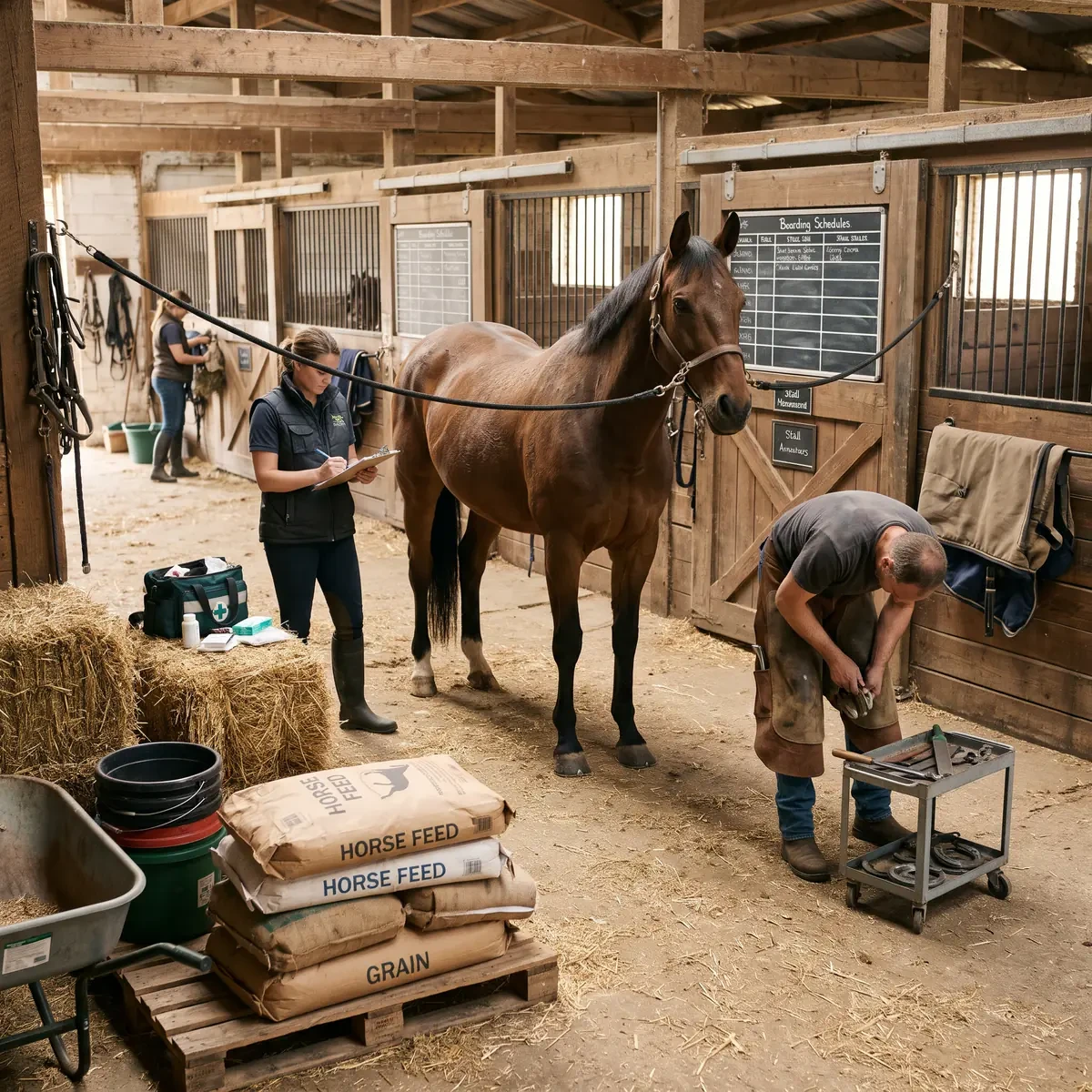
Board, farrier, vet and feed take up most of what a horse costs, and each behaves differently.
- Board is the big, steady one. It changes rarely, but when it does, it changes for everyone in the barn at once.
- Farrier is regular and non-negotiable. Hooves grow on their own timetable whether or not your account is feeling healthy.
- Vet is two bills in one: routine care you can schedule (vaccinations, dental work, check-ups) and emergencies you cannot.
- Feed includes hay, grain, supplements and bedding if you supply it. It is the bill you have the most day-to-day control over, and also the one most affected by the weather and the market.
Notice that only one of them (board) really behaves like a normal monthly bill. The other three come in lumps, on cycles, or without notice. That mismatch is why a monthly budget built on “what I paid last month” keeps failing.
How do you find out what your horse really costs?
Go back through twelve months of bank and card statements and pull out every horse-related payment. Twelve months matters because it catches the things that only happen once or twice a year: vaccinations, dental visits, clipping, a new girth, the trailer service. Then divide the total by twelve.
That number is your real monthly cost. For many owners it is noticeably higher than the number they carry in their head, which is exactly why it is worth knowing.
Sort the payments into groups as you go:
- Fixed: board, insurance if you carry it.
- Regular: farrier, feed, bedding.
- Periodic: routine vet care, dental work, vaccinations, clipping.
- Gear and extras: tack repairs, blankets, fly protection, lessons, entry fees, hauling.
If you only have a few months of records, use what you have and add estimates for the periodic items. Ask your farrier and vet how often they expect to see your horse, and let them tell you rather than guessing. Their answers turn a vague worry into a line in a spreadsheet.
Once you have the real figure, compare it to what you can comfortably afford. Better to find a gap now, with time to respond, than at the checkout of a tack shop.
Where is there real wiggle room, and where is there none?
Not every bill flexes, and pretending otherwise leads to bad decisions. Here is an honest sort.
Almost no wiggle room
- Farrier visits. Stretching the interval to save money tends to cost more later, in hoof problems and in lameness. Your farrier sets the schedule for good reasons.
- Core vet care. Routine vaccinations, dental work and parasite management are what keep the surprise bills smaller and rarer.
- Board, in the short term. You can change it, but not quietly in the middle of the month.
Some wiggle room
- Farm call fees. If several horses at your barn need the vet or farrier, booking the same day often means the call-out is shared. Ask your barn manager whether anyone coordinates this. If nobody does, you could be the person who starts.
- Being ready when the farrier arrives. A horse that is caught, clean and calm saves time, and time is what you are paying for.
- Gear. Repairing before replacing, buying out of season, and asking whether a thing is a need or a want are all fair games. A second-hand saddle pad is just as warm on a horse’s back.
The most wiggle room
- Feed. This is where careful owners can often make the biggest difference, but it needs care. Measure what you actually feed instead of eyeballing it, ask your vet before cutting anything, and check whether each supplement is doing a job. A lot of feeding habits come from folklore rather than need, and the post on horse feeding myths goes through several of them. Cutting feed blindly is a false economy, so change one thing at a time and watch your horse’s condition.
- Hay purchasing. If you have somewhere dry to store it and the barn allows it, buying in bulk when supply is good can smooth out the price swings. If you do not have storage, that is not an option, and no amount of wishing will change it.
The aim is not to squeeze every bill. It is to know which two or three have real give, and to leave the rest alone.
Does your board arrangement still fit your life?
Board is usually the largest bill, so it deserves a periodic honest look, ideally once a year and not only when money is tight.
Ask what you are actually paying for. Full board, part board, self-care and pasture board all split the work and the money differently. A cheaper arrangement that costs you two hours of driving and mucking every day is not necessarily cheaper once you count your time and your fuel. A pricier one that gives you back your evenings might be worth it, or might be a luxury your budget cannot carry.
Some questions worth sitting down with:
- How many days a week do you really get to the barn, and has that changed?
- Are you paying for facilities (an indoor arena, a round pen, trails) that you rarely use?
- Is your horse’s turnout, care and feeding good where he or she is now? A bargain that compromises the horse’s welfare is no bargain.
- Would a different arrangement, such as a part-board or a working-board deal, fit your life better?
Space is a big part of this calculation, and there is more than one way to think about it. The post on small-space horse care looks at the problem from the urban end, which can be a useful change of angle even if you board in the country.
If you do decide to move, factor in the cost of the move itself: hauling, a new deposit, and possibly new feed your horse needs time to adjust to.
How do you plan for the vet bill you did not see coming?
You cannot predict which bill, but you can predict that one will arrive. So plan for the category, not the event.
Build a vet fund. Set aside a fixed amount every month in a separate account, even a small one, and treat it as a bill you owe. When nothing happens, the fund grows. When something does, it is already there. A fund that exists before the emergency is far easier on the nerves than one assembled during it.
Ask your vet real questions. Ask what an emergency call-out typically involves, what a basic colic work-up looks like, and what the payment expectations are. Vets answer these questions all the time, and the answers let you set a target for your fund based on your area, not on guesswork.
Look into insurance with open eyes. Read the exclusions, the annual limits and the rules about pre-existing conditions before you sign. For some owners it is a sensible safety net, and for others the premiums and exclusions make it a poor fit. The decision is worth making deliberately.
Decide the hard questions while you are calm. What would you do if a major surgery were suggested? Where is your limit, and who would you talk to? Making those decisions in advance, with a clear head, is kinder to you and to the horse than making them at midnight in a clinic car park.
What helps when the numbers still do not add up?
Sometimes the honest total is simply more than your income comfortably supports. That is a real situation, and it is not a character flaw. It is a prompt to look at options early, while there are still several.
- Talk to the people you pay. Barn managers, farriers and vets are used to owners under pressure. Ask about payment timing, bundled visits, or lower-cost arrangements. Asking costs nothing.
- Share the load. A half-lease or a shared arrangement with a trusted rider can split the bills and the workload, as long as expectations and responsibilities are written down before anyone rides.
- Pause the extras. New tack, competition entries and upgrades can wait. Horses do not know the difference between a new bridle and a mended one.
- Rework board as described above, if it is the one large bill with room to change.
- Add income if that is realistic for you, whether through extra work or by selling gear you no longer use.
- Plan an exit if you must. If the numbers will not work in any version, finding a good home for a horse with plenty of notice is a responsible decision, not a failure.
Whatever you choose, tell yourself the truth about the numbers, then plan from there. A calm budget with honest figures beats a hopeful one every time, and your horse will not notice the spreadsheet, only the hay.
Share what worked for you
What is the one thing that helped you keep horse costs under control, or the bill that surprised you most? Tell us in the comments, so we can all learn from each other’s mistakes and from the bargains alike ☕
Registration and insurance card holder for horse on Amazon
Enjoy your equestrian journey! 🚀
Build Your Online Business
and Learn Affiliate Marketing
See you there!
Our Unique Value Propositions
Discover why Chwals GPT is the top choice for equestrians looking
to build their online presence (register for free)
Tailored Equestrian Expertise – Community Connection – Intuitive User Experience