Read the Label Before You Buy the Tub
Some do, and many do not. A horse on good forage and a feed that suits its workload often needs very little extra, so look at what it already eats before you add anything.
The feed store aisle is built to make you doubt that. Every tub promises a shinier coat, softer joints or a calmer mind, and every tub costs more than you expected. This guide gives you a few questions to ask before the tub goes in the cart.
Do Horses Need Supplements?
A supplement fills a specific gap. Forage changes with the field, the cut and the season, so a gap in one barn may not exist in the next. A joint powder will not fix a hay shortage, and a hoof pellet will not make up for a diet that is wrong in the first place.
Start with the basics. Is the horse getting enough good hay or pasture? Is the feed fed at the amount the bag recommends? Is the weight steady? If the answers are yes, the case for a tub gets thin. A horse has a better chance of being short on something it is missing than on something you merely suspect it lacks.
Feeding advice also travels fast around a barn, and not all of it is solid. If you want to sort the noise from the useful bits, everyone at the barn has an opinion on your horse’s feed, and this is a good place to start sorting.
What a Supplement Is For
A good reason to feed a supplement is usually specific and checkable. Here are the common ones.
- Hay tests show a mineral or vitamin is low for your horse’s needs.
- The horse eats only a small amount of fortified feed, so it gets less of the added vitamins and minerals than the bag assumes.
- A horse sweats heavily in work and needs its electrolytes replaced.
- A vet has diagnosed a condition and suggested a particular product.
A poor reason is guilt. Walking past the shelf and thinking “my horse is eight, perhaps it needs joint support” is how a monthly bill grows. The horse has no opinion on your shopping, and a full tub on the shelf does not prove you love it more than the owner next door. 🙂
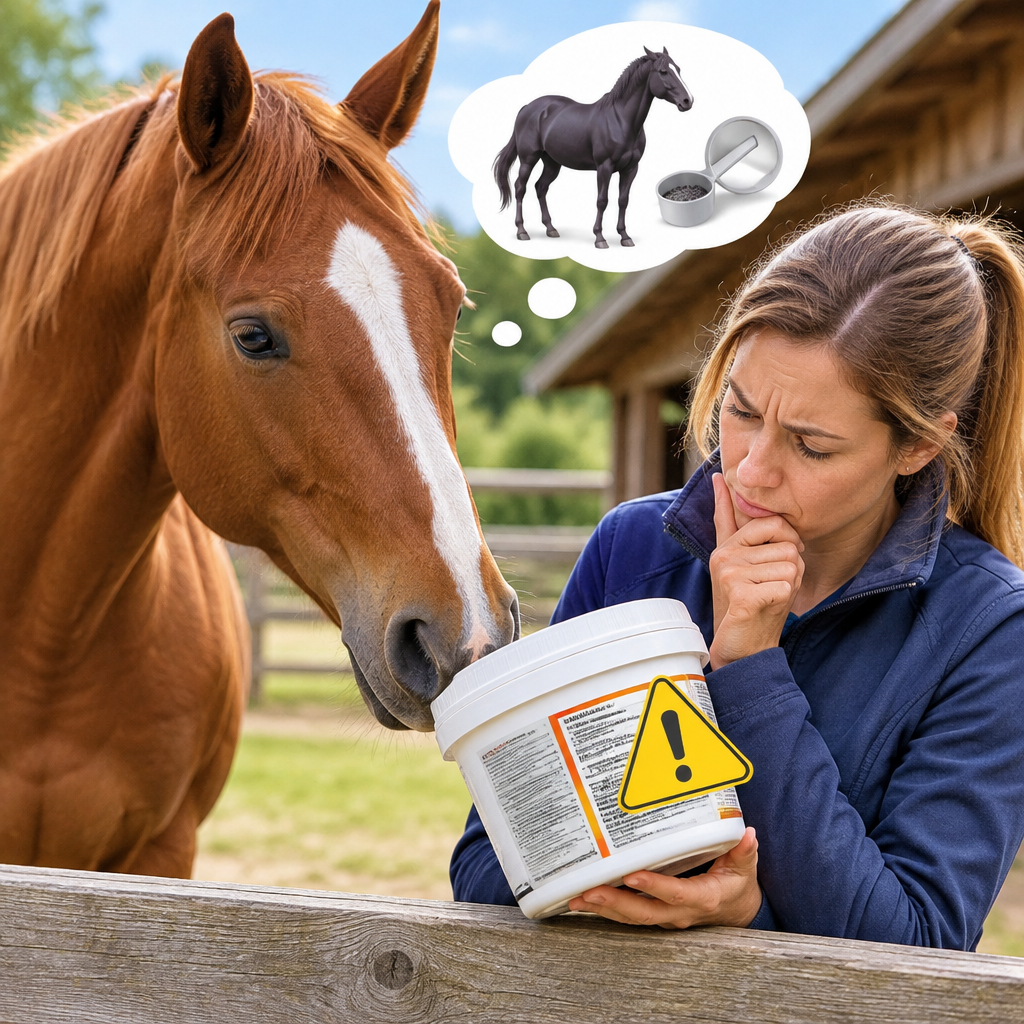
Read the Label Like a Skeptic
The front of the tub is marketing. The back is the part that tells you something. Turn it over and look for these.
- Serving size. The price per tub means nothing until you know how many days it lasts at the recommended dose.
- Amounts per serving. An ingredient listed without a quantity tells you it is in there, not whether it is enough to matter.
- Ingredient order. Ingredients are normally listed by weight, so a filler at the top and the star ingredient near the bottom tells you the real story.
- Guaranteed analysis. This shows protein, fat, fiber and the minerals the maker is willing to put a number on.
- Contact details. A maker who answers questions about the formula is a better bet than one who does not.
Then compare it with what the horse already gets. Many feeds are fortified with vitamins and minerals, so a supplement can double up on something already covered. Some minerals, selenium among them, do harm in excess. More is not a safer default.
Spot the Phrases That Say Nothing
Label language is a craft. Some phrases sound like a promise and commit the maker to nothing.
- “Supports” and “promotes.” These describe a hope, not a result. “Supports healthy joints” is not the same as “treats lameness.”
- “Proprietary blend.” The ingredients are named but the amounts are not, so you cannot judge the dose.
- “Natural.” Plants contain active compounds, and active compounds can cause problems. Natural describes the source, not the safety.
- “Vet recommended” or “clinically proven.” Ask which vet, and which study. If the label cannot point to either, the phrase is decoration.
- “Calming” or “focus.” If you compete, check your rulebook first, since some ingredients in these products can be prohibited.
None of this means every product is useless. It means the burden of proof sits with the tub, not with you.
Ask Your Vet First
A vet visit sounds like a bigger step than buying a tub, yet it often costs less than months of guessing. Call before you buy when you see any of the following.
- Stiffness, short strides or reluctance to go forward
- Weight loss or gain that you cannot explain
- A dull coat, poor hoof quality or a change in appetite
- A sudden change in behavior, since pain often looks like attitude (the piece on whether a horse that bolts, rears or won’t load is a training or a pain problem covers this)
- A horse with a metabolic condition or a history of laminitis, since some feeds and supplements carry sugar or starch that make matters worse
The vet can also run bloodwork, look at the teeth and help you read a hay analysis. A tub does none of those things. A supplement can hide a symptom while the cause keeps growing, and that is an expensive way to lose time.
Trial a Supplement Honestly
If a product passes the label test and the vet agrees, give it a fair trial. Fair means a plan, not a feeling.
- Write down the starting point. Note the weight, the coat, the hoof condition, the way the horse moves and whatever you hope will change.
- Change one thing at a time. If you add a supplement and a new feed in the same week, you will never know which one did what.
- Set a trial length with your vet and stick to it.
- Take photos in the same light and the same spot, since memory is a generous editor.
- Stop at the end and compare. If you cannot name a change, you have your answer, and the money can go back into hay.
Be wary of the owner who says the horse looks better, and then admits the horse also had a new rug, new weather and a new rider. Several things changed, and credit went to the tub.
Check Your Shelf Tonight
Go to the feed room with a pen and a notebook. For every tub, bucket and bag of powder, write down the following.
- What it was bought for, in one sentence
- The amount fed per day and the cost per day
- Whether any ingredient repeats something in the feed
- Whether anything has visibly changed since it started
If you cannot answer the first line, that tub is a candidate for retirement. Take the list to your vet or nutritionist and let them cross things out. Fewer products usually means a simpler routine and a clearer picture of what the horse actually needs. Cost is part of that picture too, and horse costs keep climbing, so trimming the shelf is one of the few savings that does not touch the horse’s care.
Common Questions
Can I feed several supplements together?
You can, but the totals add up. Two products with the same mineral can push the daily amount past what the horse needs. Add up the amounts from the feed and every tub, then check the total with your vet.
Is a natural supplement safer?
Not automatically. Herbs and plant extracts are active, and some can interact with medication or be banned in competition. Natural tells you the source and says nothing about the dose or the risk.
Does a higher price mean a better product?
No. Price tells you nothing about the amount of active ingredient. Compare the cost per day at the recommended serving, and look at the amounts on the back of the label rather than the picture on the front.
Do older horses need supplements?
Some do and some do not. Age changes how a horse chews, digests and holds weight, so a feed change may be enough, or a vet may suggest something specific. Let the horse’s condition and the vet’s advice decide, not the birthday.
What if the horse seems fine?
Then there is probably no gap to fill. A healthy horse at a steady weight on good forage and a suitable feed does not need extras to prove you care.
Tell me in the comments which supplement you have been side-eyeing on your shelf, and what made you buy it in the first place. Let’s compare notes, herd style.
Understanding horses on Amazon
Enjoy your equestrian journey! 🏇
Build Your Online Business
and Learn Affiliate Marketing
See you there!
Our Unique Value Propositions
Discover why Chwals GPT is the top choice for equestrians looking
to build their online presence (register for free)
Tailored Equestrian Expertise – Community Connection – Intuitive User Experience