Wealthy Affiliate Black Friday Review for Horse Bloggers in 2026
A plain note first.I am a Wealthy Affiliate affiliate, so I may earn a commission if you join through my link. The offer details below come from Kyle’s Black Friday post, and I send you there for them rather than repeating them from memory.
Decide if Wealthy Affiliate suits a horse blogger starting from zero
Wealthy Affiliate suits a horse lover who wants one place to build a website, host it, get help with it and learn how to run it, with no tech background needed.It suits a patient rider better than someone who expects a rosette in week one.
Think of the person this is for. You follow the eventing season, you have opinions about a cross country course that nobody asked for, and friends have started to hide when you open your mouth. A blog gives those opinions a home. It could cover event previews, rider profiles, tack questions, a beginner’s guide to watching three day eventing, or a diary of your own riding.
What stops most people is the machinery behind the blog. Domains, hosting, themes and plugins sound like a foreign language to anyone who has only ever spoken horse. Wealthy Affiliate puts those pieces inside a Hub, which is the unit you open for your website and the work that belongs to it. That keeps the horse blog and its tasks together instead of scattered across ten browser tabs.
If you already know your way around WordPress and want a bare hosting account, you may find this more platform than you need. If you are starting from nothing, that is the point of it.
Host your site without the hosting headache
Hosting is the stable your website lives in. Without it, your carefully chosen name and your first post about the Badminton cross country (or whichever event you adore) have nowhere to stand.
On Wealthy Affiliate the hosting sits on the same platform where you build the site. You are not shopping for a host, comparing plans, and then working out how to connect it to a builder. You open a Hub, build the site, and the pieces are already introduced to each other.
For a first time blogger this saves a surprising amount of nerve. The usual beginner mistake is to spend three weeks choosing a host and zero weeks writing. A horse blog with five honest posts beats a perfectly hosted blog with none.
Two things are worth checking before you commit to any platform, this one included.
- Who owns the content you write. Your articles should stay yours.
- What the hosting covers in the membership you choose. Kyle’s post is where the current terms are stated.
I will not quote numbers here, because numbers change and a stale figure helps nobody.
Get site support when the website bucks
Every website bucks eventually. A page vanishes, a menu jumps sideways, a plugin decides to unseat you in front of everyone. It is rarely dramatic, but it is always badly timed.
What matters is whether anyone is standing at the rail when it happens. Wealthy Affiliate offers support for your site, so a beginner with a broken page has somewhere to ask other than a search engine and a prayer. For someone with no tech background, that changes how a mistake feels. A mistake with a helper nearby is a short delay. A mistake alone at eleven at night can become the reason a blog is abandoned.
When you ask for help, describe the problem the way you would describe a lameness to a vet. Say what you saw, when it started, and what you changed just before. “The site is broken” gives a helper nothing to work with. “The menu moved below my header after I installed a new theme this morning” gets you an answer much faster.
Support will not write your posts or choose your topic. That part stays with you, which is fair, because you are the one who knows the difference between a good dressage test and a merely tidy one.
Use the AI tools for text, images and guidance
The platform has two Agents, a Writer and an Artist. The Writer drafts text from a brief, such as an outline for an article on how to follow a three day event as a newcomer. The Artist makes images. Between them they cover the two jobs that make beginners freeze, the blank page and the blank space where a picture should go.
Credits pay for this work. You are charged what the work actually cost, and a run that fails costs you nothing. That is worth knowing, because it lets you try a brief, see what comes back, and adjust without feeling that every attempt is a small bill.
A few honest points about using AI on a horse blog.
- A draft is a starting point. Your readers come for your eye for the sport, so add what only you know before you publish.
- Give the Writer a specific brief. “Write about eventing” produces something as bland as a plain rice cake. “Explain to a first time spectator what happens in each of the three phases” produces something useful.
- Facts about riders, results and dates deserve a check against a reliable source before they go live.
On pictures, I make my own in Picsart, so the Artist is simply there if you want it. Some bloggers enjoy drawing the post’s picture themselves, and a hand made image can give a site a personality that stock photos never will.
Guidance is the third piece. The tools can answer questions about your site and suggest next moves, which brings us to Learn.
Focus in Learn and lean on the community
Learn is the tab where the teaching lives. A Focus holds a handful of moves, and each move is something you Ask, Watch or Read. You pick a Focus that matches what you need now, such as setting up your first pages or writing a post that someone might actually find, and work through it at your own pace.
Your Hub also holds a gameplan, which is a list of tasks for your own site. The Focus teaches you the skill and the task puts it to use on your horse blog. That separation is helpful. You are never asked to study in the abstract for months while your website stays empty.
Live classes with their recordings also sit inside Learn. If you work a day job or spend your mornings mucking out, the recordings matter. You can catch a class when the yard is quiet, which is usually after dark, and rewind the confusing bit as often as you like.
Then there is the community. Other members have been through the same first weeks, and they have asked the same awkward questions. When you are unsure whether a topic is too narrow or a title too clumsy, someone has probably wrestled with it already.
One habit makes the community far more useful. Ask a specific question and show your work, as if you were asking a coach about one particular fence. People answer a clear question quickly and a vague one slowly, if at all.
Read what Kyle’s Black Friday offer includes
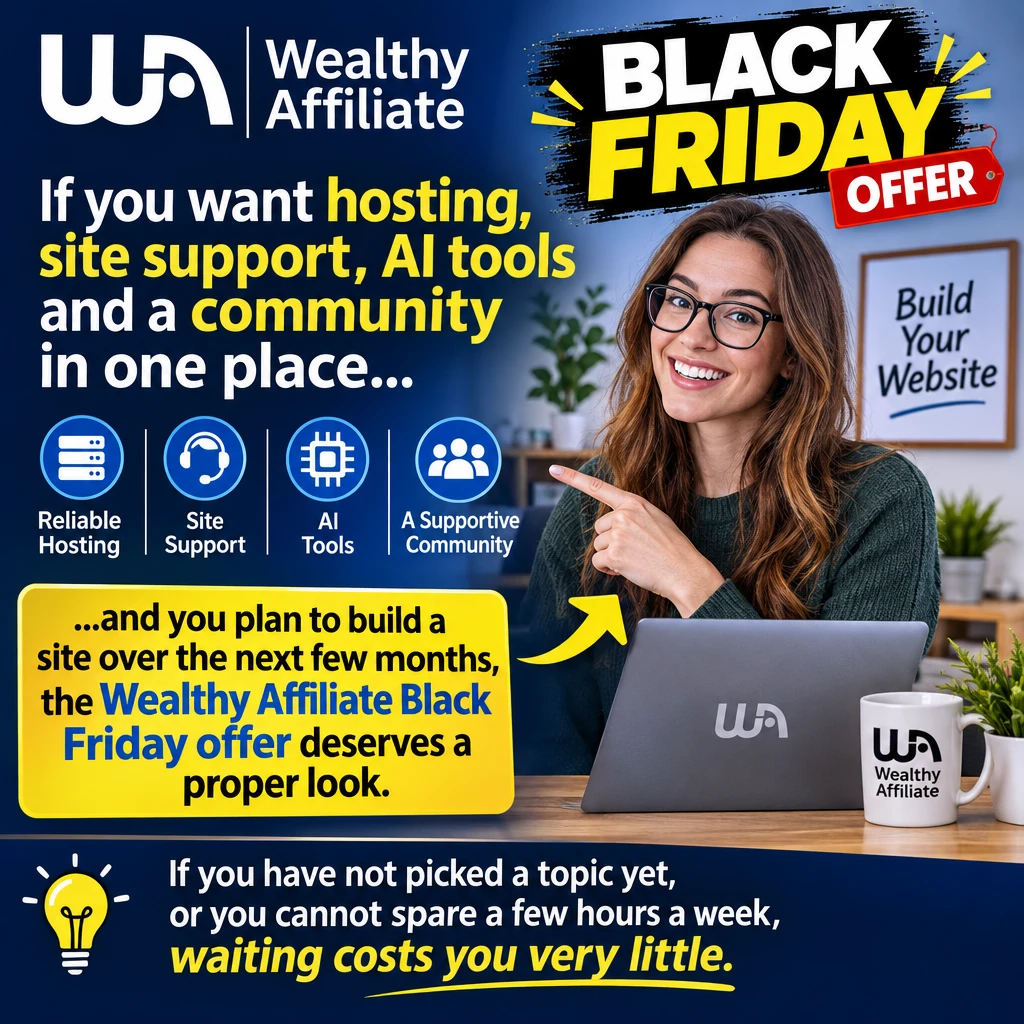
Black Friday lands on 27 November in 2026. Offers around it tend to change from one year to the next, and I would rather send you to the source than hand you a half remembered summary. Kyle’s Black Friday post is the one place where the details of the offer are set out, so treat his wording as final and mine as a guide to reading it.
Here is what I would look for when you open it.
- What exactly the offer covers. Read which membership it applies to and what comes with it.
- When it starts and when it ends. Offers with a deadline reward people who have decided in advance.
- What happens after the offer period. Find out what you will pay later, so the first bill is not a surprise.
- What you can try before you decide. Check whether a free starting point exists and what it lets you do.
- Any limits or conditions. These are usually in the smaller print, and that is where a careful reader earns their keep.
Write down your answers in plain words. If you cannot explain the offer to a friend in two sentences, read the post again before you pay for anything.
I state no prices here on purpose. A figure I quote today can be wrong tomorrow, and a deal is only a deal if you understood it when you accepted it.
Weigh the offer against your own pace and your own horse blog
A discount is only a bargain if you will use what you buy. A saddle on sale that does not fit your horse is just an expensive coat rack.
So before Black Friday, ask yourself a few practical questions.
How many hours a week can you give the blog? Two hours on a Sunday is enough to start. Writing one post every week or two for a season will build a site that shows what you know about the sport.
What will you write about? Pick a lane with room to grow. A blog about following the eventing calendar, for instance, can cover a dozen event previews, rider profiles and viewing guides before you run low on material. A blog about “horses” in general gives you too much ground and no clear path across it.
How do you like to learn? If you want a guided route and a place to ask questions, the Learn tab and the community match that. If you prefer to figure everything out alone and want only hosting, you may prefer a lighter setup.
And what is your timeline? A blog is a long hack, not a sprint. Readers and search engines both take time to notice a new site, so judge the platform by whether it helps you keep showing up every week, not by what happens in the first month.
If the answers point toward yes, the offer is worth a close read. If they point toward “maybe in the spring,” then let Black Friday pass without regret. There will be another offer, and your blog will still be waiting.
Join through my link
If you have a horse blog in your head and no idea where to begin, you can join Wealthy Affiliate through my referral link and open your first Hub, then read Kyle’s Black Friday post to see the offer before you decide. Your first post can be about the very course you plan to walk next season. 🐴
Enjoy your equestrian journey! 🏇
Build Your Online Business
and Learn Affiliate Marketing
See you there!
Our Unique Value Propositions
Discover why Chwals GPT is the top choice for equestrians looking
to build their online presence (register for free)
Tailored Equestrian Expertise – Community Connection – Intuitive User Experience